

“There is a fine line between free speech and hate speech. Free speech encourages debate whereas hate speech incites violence”
– Newton Lee
Freedom of speech is quintessential for maintaining the democratic values of a republic because it capacitates us to exchange distinct dogmas and beliefs. Article 19 of the Constitution of India undertakes the right to “Freedom of Speech and Expression.” However, freedom of speech isn’t an absolute right in the Indian constitution system; the Constituent Assembly included the “Right to freedom of speech and expression” in the Constitution of India in 1950 with some restrictions that permit the government to limit freedom of expression “in the interests of the sovereignty and integrity of India, the security of the state, friendly relations with foreign states, public order, defamation or incitement to an offence”.
In the present situation, the Government has made the volitional attempts to dominate and violate this right. Media is also held liable when it abuses free speech. According to Press Freedom Index 2019 records, India’s rank has fallen down two positions globally and is ranked at 140th out of 180 countries (source). There are many cases when Indian media (both digital and print) has tried to restrain free speech in the last few years. Newsreaders on television and politicians using strong language on national media which clearly breaches free speech and is labelled as hate speech. The major problem is the narrative practised by media houses, which often leads to fabricated allegations of individuals. People who made opinions and questions to the administration are introduced as the anti-nationals or threat to national integrity. As the press is known to be the fourth pillar of a democracy, it has a remarkable influence over society.
Incidents of hate speeches-
- In 2015, civil rights activists Vrinda Grover and Kavita Krishnan in a written letter criticized Times Now’s news anchor Arnab Goswami for using words like ‘Naxal’, ‘terrorist’ and ‘terrorist sympathizer’ and further said that he was exploiting the power of the press.
- In 2016, the news reporter of Times Now denounced JNU student leader Umar Khalid, the reporter described him as ‘more threatening to this country than Maoist terrorists’ and anti-national.
(source)
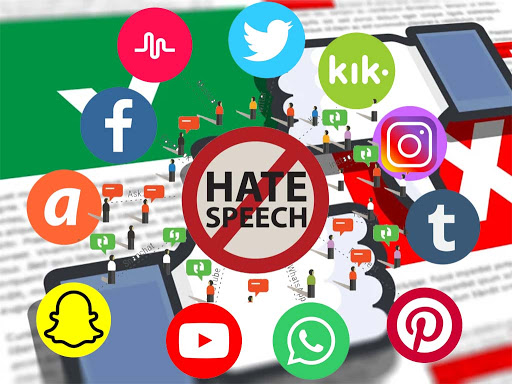
Social media platforms or sites, particularly WhatsApp, have become a medium for the circulation of rumours, instigating messages, and altered facts.
Fake messages generated by the corrupt users are shared blindly has resulted in public unrest, violence, and loss of innocent lives. This issue chiefly rises during the time of political campaigns & elections. Hate speech has ruined the democracy of the country extensively in recent times.
Science supports the notion that hate speech can result in deeper wounds at both social and individual levels. Some neurological and sociological research has proven that hate speech can cause ‘a dehumanizing effect’ which depresses our empathy for others. A number of studies by a lawyer and a neurology professor leads them to hypothesize that: our brain which produces empathy responds best when we witness the pain or grief of people. An individual’s humanity, empathy, or generosity is essential to the acknowledgement and enforcement of that person’s rights. When we dehumanize people we are less affected by their sufferings. This is also true with political, legal, and ethical. An extreme form of this roughness targeted against a specific group, but it also makes us more likely to tolerate and less likely to be bothered by denial of the rights we ourselves take for granted.
Hate Speech can result in shared viciousness, riots, the destruction of society or more awful, killing of individuals. Hate speech has become one of the most distressing subjects of today’s situation and we can’t completely blame on a particular group of people. It’s our shared responsibility to verify whatever we listen in our surrounding whether it is reliable or not and shouldn’t promote anything which embraces the hate speech.
Reference:


