

Peek into India-US History — After 200 years long and strenuous endeavour, on 15 August 1947, India gained its independence but this was not the end of the problems for India. The freedom itself came along with the economic, social and political problems that stood as the stumbling block in the way of its growth.
The United States always had friendly relations with India which remained the same even after independence. In the late 1940s, Henry S. Truman, the then president of the U.S. inclined interest towards supporting India as a result of most strategic planners considered India as a valuable diplomat in south-east Asia. The U.S. was obviously expecting India to be on its side in the ongoing Cold War between the Soviet Union and the United States. However, Nehru govt continued to follow the policy of neutrality and non-alignment based on national-interest and to avoid the involvement in Cold War strategic manoeuver.
Truman administration indicated it would favour Nehru anything he asked for. He proudly refused and thereby forfeited the chance for a gift of one million tons of wheat. American officials obviously perceived it negatively and created issues but not for long as India backed the USA in 1950 United Nations denouncing North Korea’s barbarity in the Korean War. We continued with quite favourable relations with the USA. First time since Indian independence, the US provided $1.7B in aid as well as $931M worth of food supplies. In 1959, Dwight D. Eisenhower became the first US President to visit India to strengthen the pitch between the two nations. In 1961, the US promised $1B in development loans, including $1.3B of free food (source).
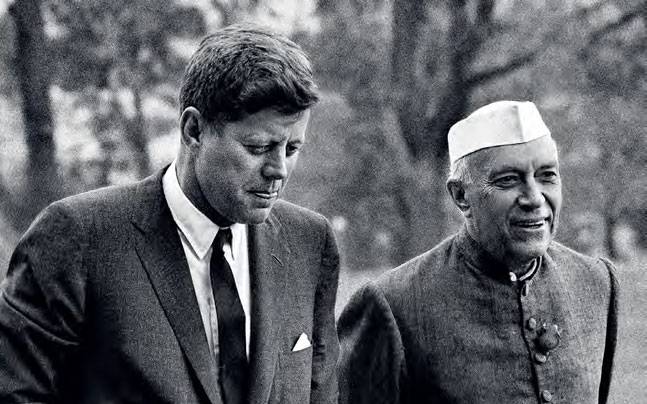
Later, the JFK administration considered India a strategic ally and reinforced during the 1962 Sino-Indian war(source). In defence of India, Kennedy stated, “We should defend India, and therefore we will defend India.”
A National Security Council meeting held in May 1963, US officials discussed contingency planning that could be approached in the event of another Chinese attack on India. Defence Secretary Robert McNamara and General Maxwell Taylor advised the president to use nuclear weapons should the Americans intervene in such a situation(source).
Prominent economist John Kenneth Galbraith, Kennedy’s ambassador to India considered close to India. As an economist, he also authorised over the (of that period) largest US foreign aid program to any ally. He also helped in the formation of the first computer science department of India, at the Indian Institute of Technology in Kanpur.
Post Kennedy’s assassination in 1963, India-US relations worsened abruptly. In the early 1970s, terms went to an all-time low under the Richard Nixon administration as India was now under the leadership of Indira Gandhi. Nixon considered Pakistan as an important partner to oppose Soviet power in the Indian subcontinent and set up links with China, with whom Pakistan had favourable relations. During the first Indo-Pak war, in 1971, the USA openly supported Pakistan by aiding them in terms of defence and economy. He Infracted away from the neutral stand which his forerunner had adopted towards Indo-Pak conflict.
NDA Govt & Nuclear Weapon Test
In the late 1970s, the newly formed Janata Party came into power with leader Morarji Desai who became the Prime Minister and over the time India improved its relations with the US, now under the presidency of Jimmy Carter. In 1974, India performed its first nuclear test, Smiling Buddha, which was rebuked by the US, it also cleared that the test did not contravene any agreement. Later, President Jimmy Carter inked an order in 1978 barring nuclear material from being exported to India due to India’s non-proliferation record(source).
The Reagan Administration equipped limited assistance to India. India expressed interest on the purchase of a range of US defence technology, counting F-5 aircraft, radar, night vision goggles and supercomputer. In 1984 Washington permitted the supply of selected technology to India including engines for prototypes for combat aircraft and gas turbines for naval frigates.
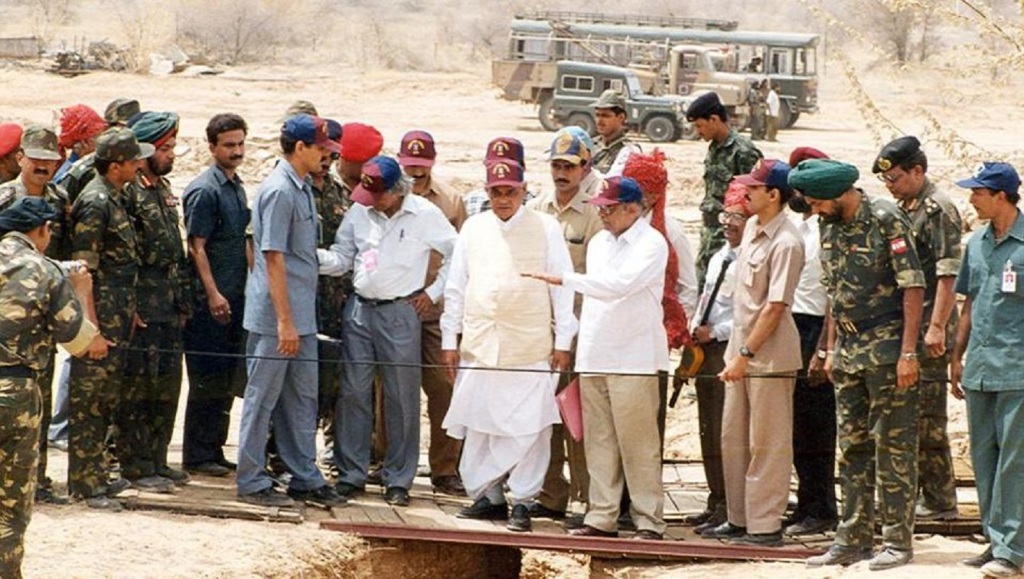
In the late 1990s, when Atal Bihari Vajpayee again came into power and he granted permission for nuclear weapons testing at Pokhran. The United States vehemently reprimanded this testing and voted in favour of a United Nations Security Council Resolution condemning the tests. President Bill Clinton imposed economic sanctions on India under the terms of the 1994 Nuclear Proliferation Prevention Act(source).
Including suspending all military and economic aid, rejecting loans by US banks to state-owned Indian companies, embargo on loans to the Indian government for all except food purchases, restraining US aerospace technology and uranium exports to India and forced other nations to oppose all loan requests by India to international lending agencies. However, these sanctions were found inefficient as India was undergoing through a strong economic growth (after the introduction of LPG), and its trade with the US only comprised a small amount of its GDP. While only Japan joined the US, while most other nations continued to trade with India. Non-proliferation dialogue widened many gaps between both countries. The sanctions were soon lifted in late September 2001. Subsequently, the Clinton administration and Prime Minister Vajpayee exchanged representatives to help rebound relations.
In December 2006, the US council passed the historic India–US Civilian Nuclear Agreement (Henry J. Hyde India-US Peaceful Atomic Cooperation Act), which allows direct civilian nuclear trade with India for the first time in 30 years. US policy had been opposed to nuclear cooperation with India in preceding years because India had developed nuclear weapons against international conventions and had never signed the Non-Proliferation Treaty (NPT). The ratification clears the way for India to purchase US nuclear reactors and fuel for civilian use.
India–US Civil Nuclear Agreement also pointed to as the “123 Agreement”, signed on 10 October 2008 is a bilateral contract for peaceful nuclear cooperation which governs civil nuclear trade between US and Indian firms to partake in each other’s civil nuclear energy sector. For the contract to be viable, nuclear suppliers and operatives must comply with India’s 2010 Nuclear Liability Act which specified that nuclear suppliers, contractors and operators must bear financial responsibility in case of an accident(source).
India rose in the 21st century as increasingly vital to core US foreign policy interests. India, a dominant player in its ground, and the home of more than one billion citizens is now often identified as a nascent Great Power and a “crucial ally” of the US also many analysts view it as a potential counterbalance to the growing clout of China. During the tenure of the George W. Bush administration, relations between India-US were seen to have bloomed. President Bush said, “India is a great representative of democracy. It is devout, has diverse religious heads, but everyone is comfortable about their religion. The world needs India”. In March 2000, U.S. President Bill Clinton visited India, pledging bilateral and economic discussions with Prime Minister Vajpayee. The visit also resulted in the foundation of the Indo-US Science & Technology Forum(source). After the 9/11 attack against the US in 2001, President George W. Bush worked closely with India in constraining and policing the strategically critical Indian Ocean sea lanes from the Suez Canal to Singapore.
India-US Economic Growth & Strategic Partnership
After the December 2004 tsunami, the US and Indian navies cooperated in search and rescue operations and within the reconstruction of affected areas. Since 2004, Washington and New Delhi have been proceeding a “strategic partnership” that supports shared values and usually convergent geopolitical interests. Further global, security and economic initiatives were undertaken into consideration. Moreover in 2005, with the goal of expanding bilateral security cooperation, the United States and India signed a ten-year defence framework deal. The two countries involved in numerous and extraordinary joint military exercises and significant US arms sales to India were arranged. In April 2005, An Open Skies Agreement was signed to enhancing business, tourism and trade by the increased number of flights, and Air India purchased 68 US Boeing aircraft at a cost of $8 billion(source). A bilateral Agreement on Science and Technology Cooperation was lockdown in 2005. After Hurricane Katrina, India donated $5 million to the American Red Cross and sent two planeloads of relief supplies and materials to help(source). Subsequently, on 1 March 2006, President Bush made another strategic visit to India to further expand relations.
Between 2004 to 2008, the value of all bilateral trade tripled and continues to grow, while significant two-way investment also grew and flourished.The influence of a large Indian-US community was indicated in the largest country-specific caucus in the United States Congress, while between 2009–2010 more than 100,000 Indian students have attended American colleges and universities(source).
In November 2010, President Barack Obama made a visit to India, in November 2010, and addressed a joint assembly of the Indian Parliament, where he upheld India’s request for a permanent seat on the United Nations Security Council(source).
India-US Strategic Bilateral and military determinants
In March 2009, The Obama Administration approved the sales of eight P-8 Poseidons worth US $2.1B to India, another deal of the $5B agreement to provide Boeing C-17 military transport aircraft and General Electric F414 engines signed during Obama’s November 2010 visit, made the US one of the top three military suppliers to India(after Israel and Russia).(source)
US Chairman of the Joint Chiefs of Staff Mike Mullen has urged stronger military links between India and the United States, and said that “India has emerged as an increasingly important strategic partner [of the US]”. US Undersecretary of State William Joseph Burns also stated, “Never has there been a moment when India and US meant more to each other.” On August 1, 2012, The Deputy Secretary of Defence, Ashton Carter, through his address to the Asia Society in New York said that India–US relationship has a global expanse, in terms of the reach and influence of both countries. He also mentioned that both countries are strengthening the relations between their defence and research & development organisations(source).
In June 2010, the United States and India re-involved in the India-US Strategic Dialogue started under Bush administration. Strategic Dialogue delivered a mutual statement in which the two countries promised to develop people-to-people, business-to-business, and government-to-government ties for mutual interests, stability, economic growth and prosperity of both nations(.
It drew extensive bilateral initiatives in each of 10 chief areas:
- Advancing global security and countering terrorism,
- Disarmament and nonproliferation,
- Trade and economic relations,
- High technology,
- Energy security, clean energy, and climate change,
- Agriculture,
- Education,
- Health,
- Science and technology, and
- Development.
(source)
Obama announced US support for India’s permanent membership on the UN Security Council in a major policy change. Calling the India–US relationship “a defining partnership of the 21st century”, he also declared the discharge of restrictions over export control on Indian companies and closed trade deals worth $10B, expected to generate 50,000 jobs in the US(source).
According to U.S. Census data, Indians have dominated every other ethnic group pertained to knowledge-based income creation. Indian American households are the most flourishing in the US with median revenue of US $100k followed by Chinese Americans at US$65k. The average household revenue in the USA is US$50k.
2014 Onwards…
On 26 May 2014, Narendra Modi became the Prime Minister of India. Since then, Modi has travelled many times to the USA for bilateral talks, diplomatic strategies and economic welfare of both countries. US President Barak Obama made a reciprocal visit in India and became the first US president to be the chief guest of the 66th Republic Day celebrations of India held on 26 January 201. India-US held their first-ever bilateral dialogue on the UN and multilateral issues(source). Modi toured the Silicon Valley met with entrepreneurs and several American business leaders and invited them to join ambitious Make in India program in an endeavour to make India a manufacturing hub. On 8 November 2017, the US had pledged a grant of nearly US$500k for organisations which can come up with ideas and projects to promote religious freedom in India and Sri Lanka.


In October 2018, India signed the historic deal worth US$5.43B with Russia neglecting CAATSA Act to buy four S-400 Triumf intercontinental ballistic missile defence system, the most powerful missile defence system in the world. The U.S. threatened India with sanctions over this decision(source). The United States also warned India with sanctions over the purchase of oil from Iran.
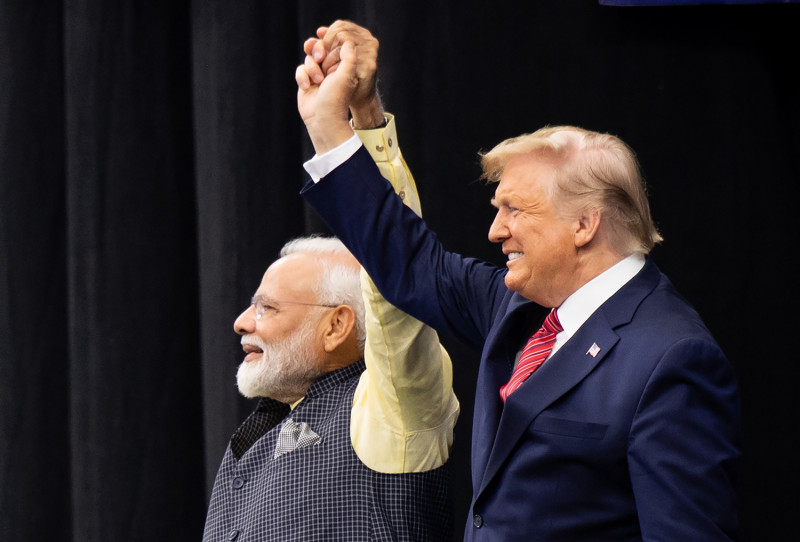
Recently, in February 2020, US President Donald Trump visited India. In his maiden visit to both nations significantly ramped up bilateral relations mainly in strategic ties and defence(source).
India-US Armed Forces Relation
The US follows four fundamental protocols with its defence allies described as “routine instruments that the US uses to promote military cooperation with partner-nations” are:
1. General Security of Military Information Agreement (GSOMIA) – It allows the sharing of military intelligence between the two countries and instructs each country to protect the others’ classified information.) In 2002, India and the U.S. locked a deal on it.
2. Logistics Exchange Memorandum of Agreement (LEMOA) – The LEMOA allows the military of either country to use others’ bases for re-supplying or carrying out repairs. The agreement does not stipulate logistical support merging on either country and demands individual approval for each request. It was signed by the two countries on 29 August 2016.


3. Communications Compatibility and Security Agreement (COMCASA) -It is an India-specific alternative of Communications and Information Security Memorandum of Agreement (CISMOA) that allows both countries to share sound and reliable communication and exchange information on approved facilities during bilateral and multinational training exercises and operations. It was signed during the inaugural 2+2 dialogue in September 2018.
4. Basic Exchange and Cooperation Agreement (BECA) – It allows the transfer of unclassified and controlled unclassified geospatial products, topographical, nautical, and aeronautical data, products and services between India-US National Geospatial-Intelligence Agency (NGA).
India-US Trading Partnership


The USA is India’s second-largest trading partner while India is its 9th largest trading partner. In 2019, the total value of India-US trade has hit $92.08 billion over 5% from 2018. according to US Census Bureau data, India exported $57.7B (rose 5.99% since last year) worth of goods to India and India imported $34.4B worth goods from the USA in 2019.
The United States is also India’s largest investment partner, with a direct investment $25.6 billion between April 2000 to March 2019 (accounting for 6.1% of total foreign investment in India).

The USA is becoming India’s major oil supplier in the last two years. After acceding with US sanctions on Iran, India has discontinued crude oil import from the Gulf nations from June 2019, onwards. Concurrently data shows, US crude supply has risen 96% in a year. India imported 87% more oil in 2019 more than $5.64B last year(source).


