Precious metals are rare which makes them valuable. These metals are very important in our modern lives for their essential properties like high conductivity, high melting point and physical and chemical resistance, catalytic ability, chemical reaction. Precious metals are used in a wide range of applications in low concentrations and often in a substance mix such as alloys or in compounds like oxides. The most well-known precious metals, gold and silver, have been used since ancient times. Rare metals include platinum (Pt), Palladium (Pd), Osmium (Os), Rhodium (Rh), Ruthenium (Ru), and Iridium (Ir). Today 85-90% gold, 60% silver is used in jewellery and 29% platinum is used in jewellery but they have many other uses, which may surprise us.
About 10 to 15% of gold is used in various applications that use its special properties. Its corrosion-resistant, static-free electrical conductivity process is used in small amounts in about 1.5 billion smartphones sold till date. It is also used in other electronic devices where efficient, high performance is required such as mounting microprocessors and memory chips onto the computer motherboards. Navigation in car and mobile phone depend on the Global Positioning System (GPS) satellites which have gold-plated component to protect them from ultraviolet light and X-ray corrosion.
Silver has the lowest contact resistance and the highest electrical and thermal conductivity of all metals which makes it essential in components of Green Technologies. Silver is needed for solar panels, fast charging, in-road applications and certain types of electrodes. It is used in circuit boards and some batteries where the speed of operation exceeds that which provides copper.
Today 40% platinum, 80% palladium and 80% rhodium are used as catalyst converters for car-bus-truck and other industrial processes. Due to platinum’s high heat resistance, its melting point is 1770°C and wear-resistant properties, it is used for contact points of spark plugs which last twice as long as conventional copper spark plugs. In health care, platinum is used in pacemakers and defibrillators. Platinum compounds are used in chemotherapy to prevent cancer.
Precious metals, their composite products and the products obtained as a result of their use really make our lives more enjoyable, safer, more productive and healthier. They enable us to have a cleaner environment today and their importance is increasing as Europe moves the world towards a low-carbon economy.
Countries With Largest Gold and Silver Reserves
In 2010, central banks around the world went from gold net sellers to gold net buyers. In 2019, public sector activity declined by 1% from the previous year, with central banks adding 650.3 tons. This is slightly less than in 2018, when banks purchased 656.2 tons. 15 Central banks made net purchases of one ton or more in 2019, highlighting the continuous demand for billion globally. Turkey was the number one buyer, adding 159 tons to reserves. Poland made the single largest purchase for the year when it bought 94.9 tons in June.
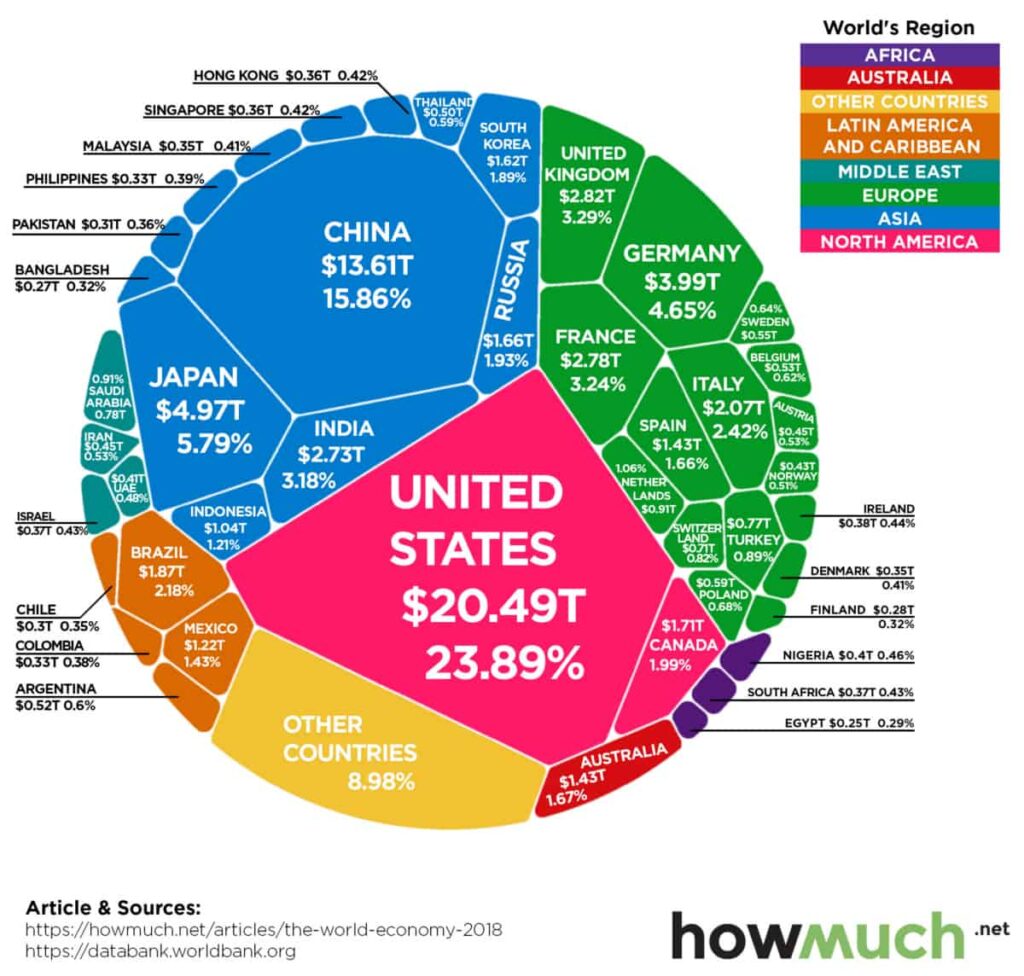
Below are top 10 countries with the largest gold holdings, starting with the Netherlands, which currently surpasses India:
Netherlands
Tons: 612.5
Percent of foreign reserves 71.4%
India
Tons: 657.7
Percent of foreign reserves: 7.5%
Not surprisingly, the Reserve Bank of India has one of the largest gold reserves in the world. The South Asian country of 1.35 billion people is the second largest consumer of the precious metals and one of the reliable drivers of global demand.
Japan
Tones: 765.2
Percent of foreign reserves: 3.2%
Japan is the third largest economy in the world and yellow is the eighth largest stockholder.
Switzerland
Tons: 1,040.0
Percent of foreign reserves: 6.5%
Seventh is Switzerland, which has the world’s largest gold reserves per capita. During World War II, the neutral country became the center of the gold trade in Europe, trading with allies and Axis powers. Today, most of its gold is traded with Hong Kong and China.
China
Tons: 1,948.3
Percent foreign reserves: 3.4%
In the summer of 2015, the People’s Bank of China began buying gold on a monthly basis for the first time since 2009.
Russia
Tons: 2,299.9
Percent of foreign reserves: 23.0%
The Russian Central Bank has been the largest buyer of gold for the past seven years and the fifth largest reserve in 2018, surpassing China. In 2014, Russia bought 224 tons of bullion in an attempt to diversify from the US dollar, as relations with the west have increased since the annexation of the Crimean peninsula in mid-2014.
Silver has been classified as a technically precious metal, but has many industrial uses. And it is used in a variety of technologies and products that most people in the developed world use on a daily basis. In 2019, silver production rose to 27,000 worldwide.
United States
The United States is the tenth largest producer of silver. In 2019 it produced 980 metric tons of metal from three silver mines and nearly 40 other base and precious metal mining operations around the country.
Argentina
With the production of 1200 metric tons of silver in 2019, Argentina established a relationship with Bolivia for the ninth place in the list. Last year its production increased to 17.6 per cent.
South America
South America is ninth on the list, along with Bolivia, a country bordering Argentina. It produced 1,200 metric tons of silver in 2019, slightly more than the 1,19 metric tons produced in 2018. The country has many silver mines especially the Cerro Rico de Potosi which is estimated to still have large deposits of silver inside.
Chile
Chile produced 1300 metric tons in 2019, which was 1370 metric tons in 2018. The size of Chile is comparable to Texas and has an estimated 27,000 metric tons of silver reserves.
Australia
Australia is a country that has a relatively stable silver production level. The country produced 1400 metric tons in 2019, although it has the third largest silver reserves after Peru and Poland.
Poland
Poland produced 1700 metric tons of silver in 2019, up about 15% from 2018. Poland holds a unique place in the silver markets: despite being a small country the size of New Mexico, it has large silver reserves of 100,000 metric tons.
Mexico
The number one silver producing country is the Mexico. In 2019, the country produced 6,300 metric tons of the metal, an increase of 180 metric tons over the past year.
Role of Precious Metal in World Economy
Metal production and metal consumption are concentrated in a few countries but locations often overlap. China is a primary center for both consumption and production, which is reflected in global industrial production. Several individual entities, including several multinational and state-owned corporations, control large market shares to produce and refine the base metal. The issue of production is not just a complete story of the importance of gold; the gold mine represents an important source of employment.
South Africa has the largest employment at 146k, followed by Russia at 138K, China at about 98K, Australia at 32K and Indonesia at 19K.
Canada spent the most capital on gold production at about $2.5 billion, followed by the United States at about $2.5 billion, Australia at about $2.3 billion, South Africa at about $1.8 billion, and Russia at a little less than $1.8 billion.
The relationship between ongoing investment capital commitment and one-time expansionary investment capital is not so strong. For example, Canada saw businesses spend $2.2 billion on one-time expansion projects, compared to $395 million in ongoing capital expenditures. South African businesses have spent $1 billion on capital needs, while investing $759 million in one-time capital expenditures alone.
The importance of gold is fully usable and is reflected in the export industries. Overall jewelry contributes about 43 percent of the total global demand. This is followed by bars and currency demand at 29%, official banking sector at 12%, electronics at 7%, exchange traded funds and similar investment vehicles at 6%, industrial demand at 2%.
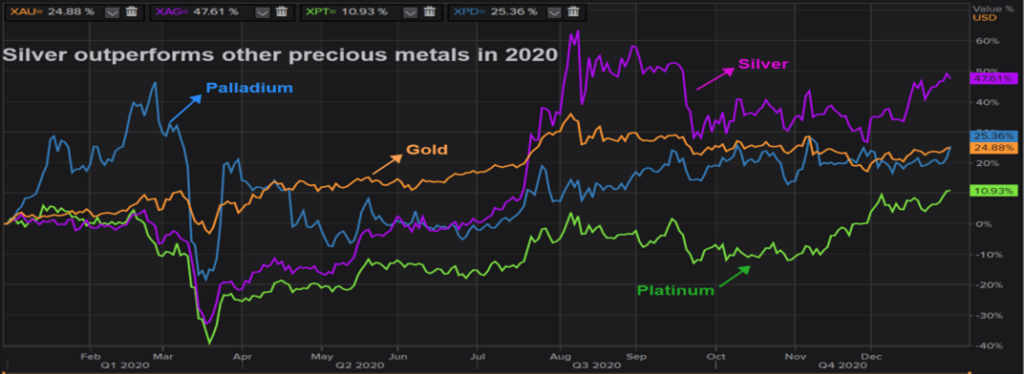
After a spectacular year, the precious metals are poised for further gains in 2021, overtaking silver, but analysts are wary of the potential for gold as the effects of the coronavirus fall on the global economy. In addition to supply shortages caused by the pandemic, gold and palladium prices have risen more than 20% this year, while silver has risen 47% and platinum 10%.
Physical gold demand was hit by the virus but reflects the investment demand of the world’s largest gold-backed exchange-trade fund, SPDR Gold Trust, which has recorded its largest annual profit of about 30% since 2009. A safe-haven asset like gold, but also an industrial metal used in products including solar panels, silver climbed from $18 an ounce in January to almost $30 in August before slipping to around $25. Most analysts expect the deficit to continue in 2021 as the global economy recovers and sales rebound.
People look for precious metals, especially in times of crisis. Many people bought both gold and silver in the 1970s due to high inflation. In fact, silver reacted twice as much as gold to those events. It has become a source of protection.
Silver may play second fiddle to gold, more expensive cousin. White metal has played a leading role in shaping the world economy from ancient Egypt to modern America. It was also an element of the military conflict that helped turn Japan into a global power before World War II. Both India and China have a long tradition of preserving silver. Gold is very rare and very expensive so almost everyone in India and China preserves their silver. China has been a huge importer of silver for many centuries, because they kept their net worth silver.
The most amazing thing about silver is the unintended consequences of Franklin Delano Roosevelt’s pro silver 1930s. This is because the price of silver has dropped by 24 cents an ounce since the Great Depression. There has been a lot of pressure from Western mining states to raise silver prices again. And Franklin Roosevelt needed a Senate vote to pass his controversial New Deal program.
The problem is America was making its coins with silver. Dimes, quarters and half dollars were made with 90% silver. The United States is the largest user of silver. Soon both JFK and LBJ limited restricted the use of silver in currencies.
Silver was four times more valuable between 2008 and 2011 when the whole world was in big trouble. Silver then worked as an insurer.
Impact of Precious Metals on Indian Economy
In the recent past the gold price rush has been so fast that India can be compared to the recession in Greece. However, Indians’ lust for gold is no secret, but it has reached a point where the country’s economy and its currency are being traded as the precious metal has fallen directly for three years. The exchange of billions of dollars of gold from foreign traders resulted in Indian cash being sent abroad and the balance of funds being disrupted. As a result, imports have become expensive and international loans have become difficult to repay.
Gold imports directly affect India’s Current Account Deficit (CAD). The larger the CAD in terms of GDP, the greater the risk to the economy as a whole. The country is currently the world’s largest importer of gold, accounting for one-third of the total supply annually. Ex-finance Minister P.Chidambaram also appealed to Indian consumers to resist the temptation to buy gold, as it would have a more positive impact on the nation’s economy. According to the Reserve Bank of India, the current gold cost is fully met through imports as domestic production of gold has come down to a very low level. Although it is considered that CAD is more sustainable for India at 2.5 per cent to 3 per cent, it is much higher than in 2011, and external resilience has been weakened by gold.
The potentially large but dormant source is the gold locked up with the temples across India. The Tirupati Temple in Andhra Pradesh, Sree Padmanabhasway Temple, Guruvayur Temple and Sabarimala Temple in Kerala Pradesh are believed to have large amounts of gold. Sri Padmanabhasway Temple has a gold holding of thousands of billions of dollars.
Action Taken by Government and RBI regarding Precious Metals
With less national gold coming to India through the banking system, the government has tried to consider raising import duties and changing the rules to address the problem. However, the recent fall in gold prices has provided the most effective solution. In August 2013, the finance minister banned countries from selling gold coins to keep the increased current account deficits. Gold imports fell sharply in 2013 to $650 million, according to the government’s domestic shipments of precious metals.
RBI has introduced 80:20 formulas under which 80% of imports will be for domestic demand, while 20% of total imports will have to be re-exported in the form of jewellery.
Conclusion
The financial crisis in late 2008 rocked global markets. The tendency to increase the temptation to allocate to regular investors began. Gold is a frontier against all kinds of uncertainties. Gold comes to recover from the prevailing global and financial uncertainties. But the government needs to crack down on rising gold prices and help investors offset losses due to uncertainties in other markets. Gold is seen as one of the best options for protecting and saving the 1.24 billion people living in India. The rise in imports over the last few years has led to a rise in the price of gold and a weakening of the rupee against the dollar. The combined effect has helped to widen the current account deficit.