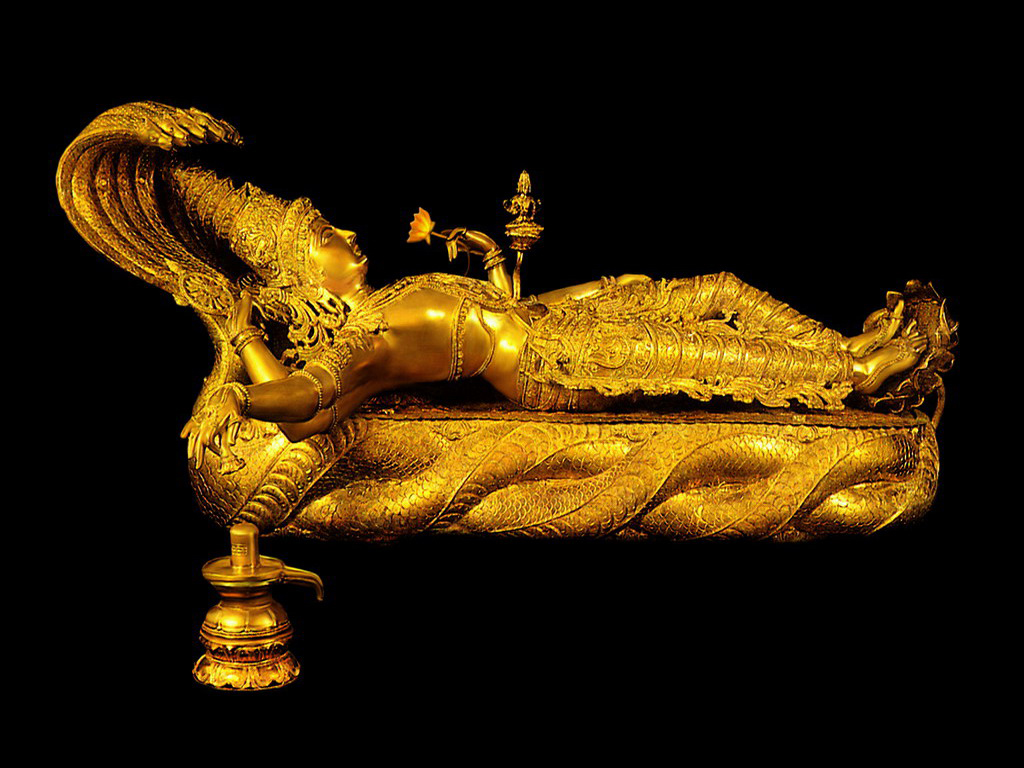
The Honourable Supreme Court of India gave the management rights of the Sree Padmanabhaswamy Temple in Thiruvananthapuram to the erstwhile royal family of Travancore. The temple has been something of an enigma, primarily because of its status as one of the richest in the world and the jewels and treasures it holds in its vaults. Historians claim that the temple dates to the 8th century, but the present structure was built and developed was built in the 18th century by the then Travancore Maharaja Marthanda Varma. The Padmanabhaswamy Temple is constructed in the distinctive Chera style of architecture, and its main deity is Lord Vishnu, who is found in the pose of Anantha Shayana (the reclining pose of eternal yoga) on Adishesha or the King of all serpents. It is known to be one of the 108 holy temples associated with Vaishnavism in India.
HISTORY OF THE PADMANABHASWAMY TEMPLE
Ever since the independence, the royal family has governed the Padmanabhaswamy Temple until 1991, when the last ruler of Travancore, Chithira Thirunal Balarama Varma, died. The state government allowed the administration of the temple to be taken over and maintained by his younger brother, Uthradam Thirunal Marthanda Varma.
THE DEITY

The Padmanabhaswamy Temple deity represents the trinity of Brahma, Vishnu, and Shiva. Legends have it that Vilvamangalatu Swamiyar, an ascetic, travelled all over the world in search of Lord Padmanabha. In Thiruvananthapuram, he had a dream that Lord Vishnu had reduced himself to 18 feet and had taken the reclining position. The idol is made of kadasharakara, a composition of herbs, raisins, and sand. The temple seen today is built of granite but previously was built of wood. The temple 365 pillars, one for every day of the year. The main idol is made of 12,500 saligram stones shipped from the Gandaki River in Nepal. Saligramas are auspicious stones worshipped and revered as the direct manifestation of Lord Vishnu.
Much attention has been given to the history of the temple, mostly because much of it is lost in antiquity. The Epics and the Puranas also mention the temple. As per the Srimad Bhagavatham Lord Balarama, brother of Lord Krishna, the incarnation of Lord Vishnu washed in Padmatheertham, a pond adjacent to the temple. It is believed by many that the construction of the Padmanabhaswamy Temple started around 5000 years ago in the early days of Kali Yuga.
THE TRAVANCORE FAMILY

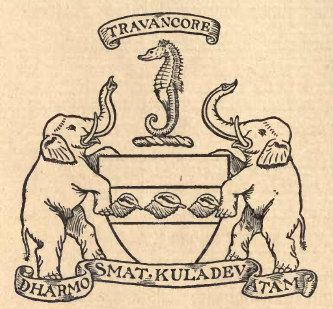
The Travancore dynasty was established by Ayyan Adigal Thriuvadir in 1870 AD. According to Uthradom Thirunal Marthanda Varma, the younger brother of the last Travancore King, their family is the oldest royal families in the country, they also surrendered the crown to the deity on 3rd January 1750. Through this action, they announced that the deity is the Maharaja and they were the servants of God. In 2011, the Kerala High Court ruling seized the right of the family to exert its shebait rights. Shebait is a person who serves the Hindu deity and who operates the temple.
THE TREASURE
There are six vaults that are found under the temple. The opening of these vaults to determine the contents that contributed to the decade-long legal battle. The Supreme Court formed a seven-member panel headed by amicus curiae Gopal Subramanium to determine the worth of the treasure, consisting of two chambers which had not been opened for more than 130 years. When vault A was opened by the Committee, the uncovered treasure estimated to be approximately Rs. 1,000,000 crores. It contained bags of gold from the Napoleonic, Roman, Medieval and British eras. They also found several gold pots and chairs that may have been used for religious ceremonies. A gold idol of Lord Vishnu adorned with diamonds and precious stone, and a 28-foot golden throne used as the seat of the deity was also found. Apart from this, a gold ceremonial robe which could have been used on the god, weighing almost 30 kg were also found. The committee also discovered sacks of gold antiquities such as coconut shelled ornaments studded with diamond and rubies, along with some jewels like diamonds, sapphires, emeralds and rubies.
THE LEGAL BATTLE
The key legal issue was whether Uthradam Thirunal Marthanda Varma, Chithira’s Thirunal Balarama Varma’s younger brother, may claim to be the “Travancore King” or his shebait rights as the “Ruler” after the king’s death in 1991. The Kerala High Court examined this claim of possession, power and management of the ancient Sree Padmanabhaswamy Temple within the restricted sense, according to the Travancore-Cochin Hindu Religious Institution Act, 1950. The High Court in its ruling stated that by relying on the powers specified in the Travancore-Cochin Hindu Religious Institutions Act,1950 (TC), Varma cannot take the position of the ruler and claim the management of the temple.
When the principal states of Travancore and Cochin signed the Accession Agreement with Government of India in 1949, the TC Act “trusted” the administration of the temple in the hands of the Ruler. When in 1991, the last ruler of Travancore died, the state government allowed Uthradam Thirunal Marthanda Varma to take over the management of the temple.
Who had the ownership, control and management of the Padmanabhaswamy temple before 1991?
All the sanctuaries which under the influence and management of the Princely States of Travancore and Cochin were under the control of the Travancore and Cochin Devaswom Boards before 1947. The administration of the Padmanabhaswamy Temple was with the Ruler of Travancore according to the Accession Agreement. The province of Kerala was cut out in 1956 however the sanctuary kept on being overseen by the royals. In 1971, through a constitutional amendment, the entitlements and privileges of the royal family were nullified. The move was maintained in the court in 1993 and the last ruler of Travancore passed away, when the case was still pending, kept on dealing with issues of the temple till then. In 1991, when the last ruler’s brother assumed the control over the temple management, it created chaos among the devotees who moved the courts prompting the legal battle. The government participated, supporting the claims that Marthanda Varma had no legal right to claim the management of the temple.
THE HIGH COURT RULING
The Kerala High Court in its 2011 decision, permitted the Travancore royal family to have a say in the customs and rituals of the temple, yet dismissed Uthradam Thirunal Marthanda Varma’s contention that he should step into the shoes of his brother, the last “King.” The leader of Travancore, the late Chithira Thirunal Balarama Varma who administered Travancore as ruler for a long time (1931 to 1949) and who was the Rajapramukh of Travancore-Cochin for six years and who dealt with the sanctuary until his passing on July 20, 1991, never guaranteed that the sanctuary was the family property of the royals or an individual property of himself. Despite the fact that the last ruler executed a will handing down his properties, he had excluded the sanctuary as his property or dealt with it, the high court uncovers in its judgment. If the temple was the family property of the royal family or the private property of the king, at that point there was no requirement for a particular provision in the Accession Agreement or the TC Act accommodating vesting of the sanctuary in trust in the possession of the last leader of Travancore. The obvious word used to qualify vesting is “in trust”, which implies, that it is to serve someone. The beneficiaries are the devotees, the state and the public and each one of the individuals who have an enthusiasm for the sanctuary. The last ruler, in this way, was a trustee who has held the control of the sanctuary to assist the devotees, the state and general society, the high court clarified in its judgment. Without a definition in the TC Act, the definition contained in the constitution’s Article 366(22) must be received to characterize “ruler,” the high court held. Only the last ruler satisfies the definition, and nobody can obtain that status, which isn’t heritable. Along these lines, none of the heirs of the family could guarantee control or the management of the sanctuary under 18(2) of the TC Act after the demise of the last Ruler, the high court held.
The High Court also gave three months to the Kerala government to comprise a body, corporate or trust, to assume control over the temple, its assets and management, and to run the same as per all the customs followed till date. Considering the assets and the valuables in the six vaults of the sanctuary, the court commanded an inventory of all the articles and displaying them for devotees and tourists on monetary premise. It likewise made a proposal to let the state police assume control over the sanctuary security, or help the current security force employed there. The High Court had reasoned that after the meaning of the word ‘Ruler’ in Article 366 (22) of the Constitution of India was changed by the Constitution Act, 1971 (26th Amendment) which nullified the privy purses, and hence the younger brother of the last ruler of Travancore could not take control over the management of the temple. However, after the High Court gave its ruling Uthradam Thirunal Marthanda Varma immediately filed an appeal against it in the Supreme Court, which in turn put the High Court order on hold.
THE SUPREME COURT RULING
The Supreme Court gave its verdict on the nine-year-long management dispute over the Sree Padmanabhaswamy Temple, a two-judge bench comprising of Justice UU Lalit and Justice Indu Malhotra upholding the rights of the erstwhile Travancore royal family. The Supreme Court found the royal family perfectly qualified to hold the “shebait” rights. The word “shebait” comes from “Sewa” which means “service”. In the literal sense, it signifies one who makes sewa to the god or a deity. For a quite a long time, the Padmanabhaswamy Temple was under the control of the Travancore royal family, they were the supervisors or the shebaits of the temple until they signed the Covenant in May 1949. In its judgment, the Supreme Court has set out that the shebaitship is vested in the founder and except if the originator himself has discarded the shebaitship in a specific way or there is some utilization or custom or conditions indicating an alternate method of devolution, the shebaitship, similar to some other types of heritable property follows the line of legacy from the founder; and it isn’t available to the court to set out another standard of progression or modify the standard of succession. By the Constitution 26th Amendment Act, 1971, the privy purses, benefits and other exceptional privileges of the past leaders of Indian states were annulled by erasing Articles 291 and 362 and by inserting Article 366(22) in the Constitution. The test against it was repulsed by the Supreme Court vide judgment rendered by the constitution seat on February 4, 1993, in Raghunathrao Ganapatrao v Union of India. The Kerala government said that with the cancellation of the idea of Ruler by the Constitution (26th Amendment) Act, 1971, the shebaitship of the royal family stopped to have any impact.
The Supreme Court brought up that it is the settled law that shebaitship has the components of office and property, of obligations and individual interest, mixed and they contribute the workplace of the shebait with the character of an exclusive right. The shebaitship of the sanctuary had likewise gone from Ruler to Ruler’s heir with principles of succession otherwise pertinent to the royal family, the court held. The Covenant let the administrative issues of the sanctuary with the royal family and in the possession of the Ruler of Travancore, essentially because his official limit or status as the past Head of the State had nothing to do with the limit as shebait of the sanctuary, it clarified.
The 26th Amendment Act erased Articles 291 and 362 and embedded Article 363A which explicitly specifies inter alia that any individual who was perceived to be the leader of an Indian state or his successor, will cease to be perceived as such ruler or successor, and all rights, liabilities and commitments in regard of privy purses stand quenched.
Article 366(22) was likewise in like manner corrected and as far as the altered definition, “Ruler” presently implies inter alia, the individual who was perceived as the leader of an Indian state or as a successor to such Ruler, before the beginning of said Constitutional Amendment.
In spite of the 26th Amendment Act, 1971, the private properties of the ruler would keep on being accessible for succession and devolution as per the law and custom, the Supreme Court held. In any case, the court likewise acknowledged the royal family’s case that’s it not, at this point thought about the sanctuary as its private property and that it just looked for shebaitship.
The bench clarified that on the day the covenant got successful, the Ruler of the Covenanting State of Travancore was shebait of the Temple, which was not in his official limit as the ruler; and that the articulation “Leader of Travancore” in the agreement and the TC Act was distinctly to recognize the individual, and that official status of the leader of Travancore had no connection with such organization.
The shebaitship of the sanctuary being detached with the official status of the individual who marked the contract must regress by the material laws of progression and custom, the court dominated. After the demise of the individual who was in charge and management of the organization, the heritable intrigue must devolve as per the standard rights, the bench dominated.
Except if and until the line of succession of the shebaitship and responsible for the organization is terminated, there can be no doubt of escheat as saw by the Kerala high court, the bench included. The principle of escheat hypothesizes that where an individual dies intestate and doesn’t leave a beneficiary who can prevail to the property, the property rests with the government. And thus, the Shebait rights, as per customary law, are with the royal family even after the demise of the last ruler. The Supreme Court ruled that for the shebait rights the definition of the Ruler given in Act would be adhered to and would transfer to the successor.
The SC acknowledged the accommodation of the royal family that the sanctuary is a public sanctuary and coordinated setting up of an authoritative advisory group with the Thiruvananthapuram District Judge as its administrator, for its straightforward organization later on. The Committee would comprise of a nominee of the trustee (royal family), the chief Thanthri of the temple, a nominee of the State and a member designated by the Union Ministry of Culture. The SC likewise requested a subsequent panel to be comprised to prompt the authoritative board of trustees on policy matters. The second committee would be headed by a retired High Court judge, selected by the Chief Justice of Kerala High Court. The essentials obligations of the two committees are to maintain the treasures and valuables of the temple.