Assam, which is often called the Gateway of Northeast India, has a diverse culture that represents the identities of the entire population, the diversity of its culture being facilitated by the three stages of cultural assimilation the State went through, beginning with the Austro-Asiatic and Tibeto-Burman groups. The population of Assam which amounts to up to 35 million is diverse in the sense that what constitutes, the people of Assam, is a broad definition that stretches to Mongolian tribes, as well as people of Indo-Aryan, Tibeto-Burman and Indo-Iranian origin.
The Ahom and the Koch kingdoms of Assam have made a great impact on the nature of the state of Assam today and hence, it’s culture. The Ahoms which ruled the kingdom from 1228-1826, is the pride of all Assamese people because it’s the only kingdom to have defeated the Mughals, 17 times in a battle. Their process of the cultural assimilation of various tribes like the Naga, Moran, Borahi, Chutiya ad Dimasa people made a drastic change in the socio-cultural life of Assam. The Ahoms eventually developed a new ‘Assamese Culture’, parts of which the natives still follow today, which was a mix of both tribal and non-tribal elements.
Role of Sankardeva in Assamese Culture
Mahapurush Srimanta Sankardev who was born in 1449, till date, remains the colossal figure for the social and religious reform in Assam, while also being a saint, scholar and a playwright.

One of Sankardev’s most highlighted contribution to the Assamese culture is believed to be the Vaishnava movement of the 15th century, which had both religious and cultural dimensions. He preached the religion of ‘Ek Sarania Nam Dharma’, i.e, absolute worship pf Lord Vishnu, through the movement of the 15th century. The partial Hinduization of communities that he achieved along with the creation of new socio-religious institutions like the ‘Namghar’ and the ‘Sattra’, has rightfully granted to him the status of a religious pioneer. But to view Sankardev as only a religious reformer and likewise, his reforms being limited to the religious sphere is an extremely contracted perception of his greatness. The Vaishnava moment in its glory also contributed to newer developments in language and literature, performing and fine arts, and also attempted to incorporate foreign elements into the Assamese culture. Sankardev was also able to give religion an artistic form, often linking religion to music. He, and his disciple, Madhavdeva who was as influential, wrote a number of holy songs known as ‘Borgeet’ which remain an important part of Assamese culture now, even hundreds of years after their composition. Sankardev also composed dramas called, ‘Ankia Naat’ and Sattriya dance was a part of it.


Therefore, Sankardev and later his disciple Madhavdev, have made an immense and irreplaceable contribution to Assamese culture, the remnants of which still remain till date.
A culture represented in symbols…
A unique feature of Assamese culture is the significance attributed to symbols in it. This cultural practice of associating one’s pride and identity as an Assamese is age-old but still remains important within the domain of culture.
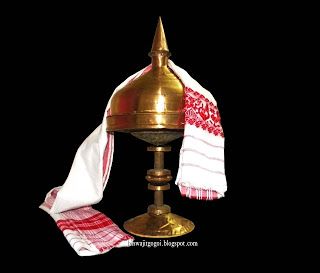
Perhaps, the most important and popular symbol of Assamese culture is the ‘Gamosa’ which is a rectangular piece of cloth that has red borders and beautifully woven prints. While literally, the Gamosa means a cloth to wipe one’s body with, it’s significance surpasses that function. It often serves as a gift that is given to respectable people while honouring them, as ‘bihuwaans’, i.e, gifts given during Bihu, at Namghars, etc. So deeply is it entrenched in Assamese culture, that in contemporary times, even Covid-19 face masks, along with different types of clothes such as shirts, etc, are made of Gamosa. It is a scarf like cloth that PM Modi is often seen dorning, although it’s frequent reference to as ‘Modi Gamcha’ sparks controversies of cultural appropriation.

Further, the ‘Xorai’ which is a traditional object of great respect and is made of bell-metal or brass or silver, also acquires great significance in terms of culture. The Xorai is used as a medium for respectful offerings in Namghars and also used as ornaments in many Assamese homes.

Another important symbol is the tamul-paan (areca nut and beatle leaves) which when offered is believed to be a sign of devotion, respect and friendship.
FESTIVALS AND CELEBRATIONS IN ASSAM
A state as diverse as Assam, which is home to about 18 tribes (Boro, Dimasa, Chutia, Sonowal, Tiwa, Garo, Rabha, Mising, Karbi, and others) and non-tribal population, celebrates a wide number of festivals.
Bihu
Bihu, which is celebrated three times a year, is the most widely celebrated and popular festival in Assam.
Bohag Bihu or Rongali Bihu, is celebrated by dancing the traditional Bihu dance and singing songs with loved ones, in mid-April. In mid-October, Kongali Bihu is celebrated. Following this comes the Harvest bihu, known as Bhogali Bihu or Magh Bihu, which is usually celebrated by feasting and burning of community bonfires, known as ‘mezi’, in mid-January.

Besides Bihu, Assam also celebrates various other major festivals such as Me-dum-me-phi, which is an ancestor worship festival observed by the whole Ahom community. The Bodos and the Kacharis on the other hand, celebrate the festival of Baishagu with grandeur.
Assam also celebrates festivals of, Durga Puja, Dol-Jatra, Ambubashi mela, Saraswati Puja, Diwali and all other national and international festivals, perhaps due to the diversity of the population that lives in the region.
TRADITIONAL CRAFT INDUSTRIES
Weaving is both a part of women’s lifestyle as well as one of the most important traditional industries in Assam. Assam boasts of having the largest concentration of handlooms and weavers all over India. Mahatma Gandhi, in reference to the traditional weaving industry in Assam, had once praised the women behind the success of the industry, as being able to weave dreams with their looms. These Assamese women, weave silk (of three varieties – eri, muga and pat) and cotton in their looms. Of all the varieties of silk produced, Muga is the most glorious and prestigious one, which is a golden cloth, known worldwide, as being the finest of India’s wild silk.
Besides the traditional silk and cotton weaves, tribal weaves are also prominent, and as prestigious in Assam. This includes ‘mirjim’ (from Majuli and N.E Assam) on blankets, mattresses and floor coverings and shawls of Karbi Anglong and Dima Hasao districts, Lasingphee blankets of bamboo and cotton in southern Assam’s Cachar district.
Equally important are the traditional bell metal and brass industries of Assam, Hajo and Sarthebari being the primary centre of such crafts. The most prominent objects made in such workshops of ‘kaah’ include Xorais, Botas, and numerous crockery items, etc, which are used for both domestic and religious purposes.

Further, Cane and bamboo craft, pottery and terracotta, jewellery making, making music instruments, etc, also remain major traditions of art and crafts in Assam.
TRADITIONAL ASSAMESE CUISINE, ATTIRE, MUSIC AND DANCE
Like the diverse state to which it belongs, Assamese cuisine is also diverse, as it accommodates and satisfies the taste buds of the multi-ethnic population. The traditional Assamese food plate consists of ‘bhaat’ (steamed rice), dal, bhaji (fried vegetables) and a fish or meat curry. Different varieties of meat and fish are a part of the cuisine namely, chicken, mutton, pork, ducks, pigeons, and even silkworms, locusts, eel, wildflower, deer meat, etc.

Some of the most popular and famous items that Assamese cuisine is known for include, ‘khaar’, pura maas mankho, dheakiyasak, pitika etc. Often, the meal must be accompanied by ‘nemu’ which means lemon and the meal ends with the consumption of ‘tamul-paan’. Further, while all this constitutes the main course, Assamese food also boasts of a variety of snacks including ‘pitha’ (made with powdered rice and coconut or other fillings), coconut ladoos, etc.
Assam tea however remains the single most important beverage which is famous nationally and internationally. It makes an appearance in almost every café nationally. Assam which produces almost half of India’s tea, is known for a deep burgundy red cup of tea with a strong odour. Tea gardens are abundant in Assam, the biggest of which are located in the Upper Assam region

TRADITIONAL ASSAMESE ATTIRE
Moving on to the traditional costumes in Assam, the non-tribal Assamese women wear ‘Mekhela-Sador’ which is a two-piece cloth, that looks almost like a saree, but is not so. The men, on the other hand, wear a Dhoti and drape a piece of cloth known as ‘seleng’ over their body.
Besides this, the various tribal groups that exist within Assam also have their own distinct and equally beautiful costumes. For instance, The men of the Dimasa tribe wear a ‘Sgaopha’ or ‘Phagri’ which is a turban-like thing that symbolizes their pride, while the ‘Rigu’ is the standard piece of clothing for women of this tribe. The women of the Bodo tribe wrap their bodies in a piece of cloth known as the ‘Dhokna’.
The diversity of Assam is also reflective in the richness of its folk music, which includes Borgeet, Bihu songs, Mising songs, Karbi songs, etc. Moreover, modern music in Assam is also diverse in the sense that people listen to all sorts of music from the legendary artists like Dr Bhupen Hazarika, Jayanta Hazarika, Khagen Mahanta, to a new younger generation of artists like Zubeen Garg, Papon and others. Guwahati, the capital of Assam, has also seen the growth of newer genres of music like rock, etc.
Apart from the Bihu Dance, which is performed during the festival of Bihu, Sattriya dance is perhaps the most respected and a prominent part of Assamese culture. It is a major classical dance of India, which was created by Srimanta Sankardeva. The core of these dances is mythological stories, represented in an artistic manner.

Other dances in Assam also include the Jumu Nach, Ali Ai Ligang Dance, Deodhani, Bhortal Nritya, Bagurumba, Khamba Lim, etc.
CONCLUSION
Therefore, the land of the red river and blue hills displays a colourful mix of cultures of the multi-ethnic population that resides in the region. This intermixture of tribal and non-tribal elements in its culture gives the culture of the Assamese, a unique character, which beholds and captivates anyone who visits Assam and bonds the people of Assam to their homeland eternally.